Family, Welfare, and the State by Mariarosa Dalla Costa Rafaella Capanna
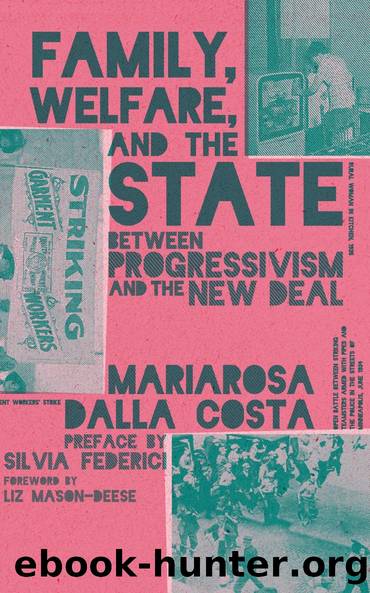
Author:Mariarosa Dalla Costa, Rafaella Capanna [Mariarosa Dalla Costa, Rafaella Capanna]
Language: eng
Format: epub
ISBN: 9781942173533
Barnesnoble:
Publisher: Common Notions
Published: 2021-09-07T00:00:00+00:00
In reality, the actual employment that the WPA was able to offer was 2.5 million jobs. The remaining jobseekers were sent back to local and state administrations.
THE NEW DEAL: TOWARD A SYSTEM OF âSOCIAL SECURITYâ
To better appreciate the overall path of struggles and changes in the institutional framework along which social aid and security would develop during the second New Deal, letâs refer to some highlights of the workersâ struggle.50 The years after Dearborn in 1932, especially 1933 and 1934, were characterized by a strong resumption of workersâ struggles. Workers took full advantage of Section 7a of NIRA despite strong resistance from individual capitalists and the state apparatus. This resistance represented the difficulty of collective capital to affirm its point of view.
NIRA was passed in June 1933. Along with the right of workers to âorganize and bargain collectively through representatives of their own choosing and [to] be free from the interference, restraint, or coercion of employers of labor,â it established the principle of minimum wage and maximum work hours.51 Soon after it was passed, struggles in the factories unfolded with particular vehemence.
In the second half of this year the number of strikes was equal to those of the entire previous year, and the number of workers struggling was three and a half times that of 1932. In 1934, there were 1,856 strikes involving 1,500,000 workers, more than seven percent of employed people. Thus, the number of conflicts was not particularly high but they involved large industries and large categories, steel and automobile workers, Pacific coast dockers, northwestern timber workers and, right up front, the loudest of all, almost 500,000 textile workers with these requests: a thirty-hour work week, a minimum wage of $13, abolition of the stretch-out (the speed-up of the textile industry), and recognition of the United Textile Workers.52
Download
This site does not store any files on its server. We only index and link to content provided by other sites. Please contact the content providers to delete copyright contents if any and email us, we'll remove relevant links or contents immediately.
| Anthropology | Archaeology |
| Philosophy | Politics & Government |
| Social Sciences | Sociology |
| Women's Studies |
The Secret History by Donna Tartt(19102)
The Social Justice Warrior Handbook by Lisa De Pasquale(12197)
Thirteen Reasons Why by Jay Asher(8918)
This Is How You Lose Her by Junot Diaz(6893)
Weapons of Math Destruction by Cathy O'Neil(6284)
Zero to One by Peter Thiel(5807)
Beartown by Fredrik Backman(5766)
The Myth of the Strong Leader by Archie Brown(5512)
The Fire Next Time by James Baldwin(5454)
How Democracies Die by Steven Levitsky & Daniel Ziblatt(5224)
Promise Me, Dad by Joe Biden(5157)
Stone's Rules by Roger Stone(5090)
A Higher Loyalty: Truth, Lies, and Leadership by James Comey(4966)
100 Deadly Skills by Clint Emerson(4931)
Rise and Kill First by Ronen Bergman(4797)
Secrecy World by Jake Bernstein(4756)
The David Icke Guide to the Global Conspiracy (and how to end it) by David Icke(4722)
The Farm by Tom Rob Smith(4517)
The Doomsday Machine by Daniel Ellsberg(4493)
